CANADA HAS HAD DEEP connections to Europe for a very long time. These offer us enduring guideposts. Canada and Europe have common values that come from a shared past, a persistent concern for stability and security, and a desire to counterbalance the overweening power of the United States.
The notion that Canada is an Atlantic nation—a country that belongs to both Europe and North America—goes back to the early 1940s, when Canadian policy makers adopted the language used by British and American leaders in the early days of the Second World War to capture the geostrategic bond between their two countries, even before the US entered the war in December 1941. The Atlantic Charter of August 1941, signed by British prime minister Winston Churchill and US president Franklin D. Roosevelt, which set out the goals for the international system after the war, is an exemplar of the Atlantic idea.
The roots of the idea actually go back to a time well before the sudden acceleration of Anglo-American co-operation after the Nazi conquest of much of western Europe. Canada’s links across the Atlantic had been deeply anchored from the time of initial European settlement and the decisions of the 1770s not to follow the American colonies into independence. The vast majority of those living in Canada had always felt the transatlantic ties of birth, family, national origin, politico-cultural inspiration, and commerce.
The North Atlantic connection very much shaped Canada’s geostrategic posture for more than forty years. The commitment to station Canadian forces in Europe was a key element, coming to an end only with the Cold War. And even after the conservative government of Brian Mulroney decided to bring this commitment to a close in 1991, the Canadian Armed Forces remained actively engaged in transatlantic politics—in the Balkans in the 1990s and in the Baltics in the 2010s and 2020s. Throughout, Canada’s status as an Atlantic nation remained central to Canadian self-perception.
The idea of Canada as an Atlantic nation was eventually joined by similar transoceanic projections involving the two other oceans that border the country. That Canada is a Pacific nation was first bruited by the Liberal government of Pierre Elliott Trudeau in 1970, repeated by every subsequent government, most recently by that of Justin Trudeau in Canada’s Indo-Pacific Strategy. The claim that Canada is an Arctic nation is relatively recent, having first been embraced by Mulroney’s government in the 1980s, although since that time, it has been used on occasion by every government, most enthusiastically by the Conservatives under Stephen Harper between 2006 and 2015.
To call Canada an Atlantic nation, a Pacific nation, or an Arctic nation may be a fanciful way to imagine the country given its very firm geostrategic location in North America, but such transoceanic projections continue to be popular because they have proven to be a useful way for policy makers in Ottawa to signal an aspirational foreign policy.
Michael Hart, a former senior foreign affairs official, once said that “Canadians have made a cult” out of wanting to be “anything but what we are, a nation of the Americas.” But that is precisely the point of the transoceanic projections: they are intended to try to forge connections with other countries as a way of altering the overwhelming dependence on the US.
MUCH OF THE ENTHUSIASM for the idea of Canada as an Atlantic nation has been driven by a desire to deal with the challenges of the huge power imbalance between the US and Canada. During the early Cold War, for example, Canadian policy makers were concerned that if the Atlantic alliance developed as having two “pillars,” or was shaped like a “dumbbell,” with a European bell or pillar at one end and a North American unit at the other, Canada would likely be relegated to a subordinate position by the dominant power in the North American bell, and its role and voice in transatlantic issues would be marginalized.
In August 1971, US president Richard Nixon’s administration suspended the convertibility of the dollar into gold and imposed a 10 percent surcharge on all dutiable imports. The “Nixon shock” galvanized the Pierre Trudeau government into a major reappraisal of the Canada–US relationship. Two options—to maintain the status quo or to pursue further integration with the US—were rejected in favour of what came to be known as the Third Option: to pursue “a comprehensive, long-term strategy to develop and strengthen the Canadian economy and other aspects of our national life and in the process to reduce the present Canadian vulnerability.”
The Third Option prompted the Trudeau government to rediscover the Atlantic idea by seeking a “contractual link” with the European Economic Community. In a trade-off that no one sought to disguise, Ottawa purchased a fleet of Leopard main battle tanks from a German firm for service with Canadian troops in Europe. But geography won out in the end. The contractual link, signed in 1976, did not markedly alter Canadian dependence on the US; by the early 1980s, Ottawa had in essence embraced the second option.
In 1985, the Mulroney government began negotiations for a comprehensive free trade agreement with the US. The agreement that came into force in 1989 was quickly supplanted by the North American Free Trade Agreement (NAFTA), signed by Mexico, the US, and Canada, leading to an intensification of economic integration over the next thirty years.
The Third Option of the 1970s may have failed, but its main goal of reducing Canadian vulnerabilities to the United States was to be rediscovered after Donald J. Trump was elected president in 2016. During his first term, Trump disrupted some aspects of the Canada–US relationship. He forced a renegotiation of NAFTA and imposed a number of tariffs on Canada. A common prescription for the Canadian government was to move to reduce vulnerabilities if Trump—or a Trump-like Republican with an “America First” agenda—returned to power in the next election. When Joe Biden won in 2020, however, such an option seemed too fanciful.
THE IDEA OF REACHING across the Atlantic returned to the forefront of Canadian policy options after Trump won the 2024 election, particularly since his foreign policy agenda took a radical turn. Even before he was inaugurated, he had threatened to impose crippling tariffs on Canada and Mexico in retaliation for what he claimed was the lax approach of these countries to stopping the supply of fentanyl to the US. He began to talk about annexing Canada as the fifty-first state, using what he called “economic force” to coerce Canada into submission.
Prime Minister Mark Carney recognized that the moves by the Trump administration represented a major breaking point in Canada–US relations. As he put it bluntly, “The old relationship we had with the United States based on deepening integration of our economies and tight security and military cooperation is over.” He suggested that his government would take steps to recast Canadian policy to fit this new development.
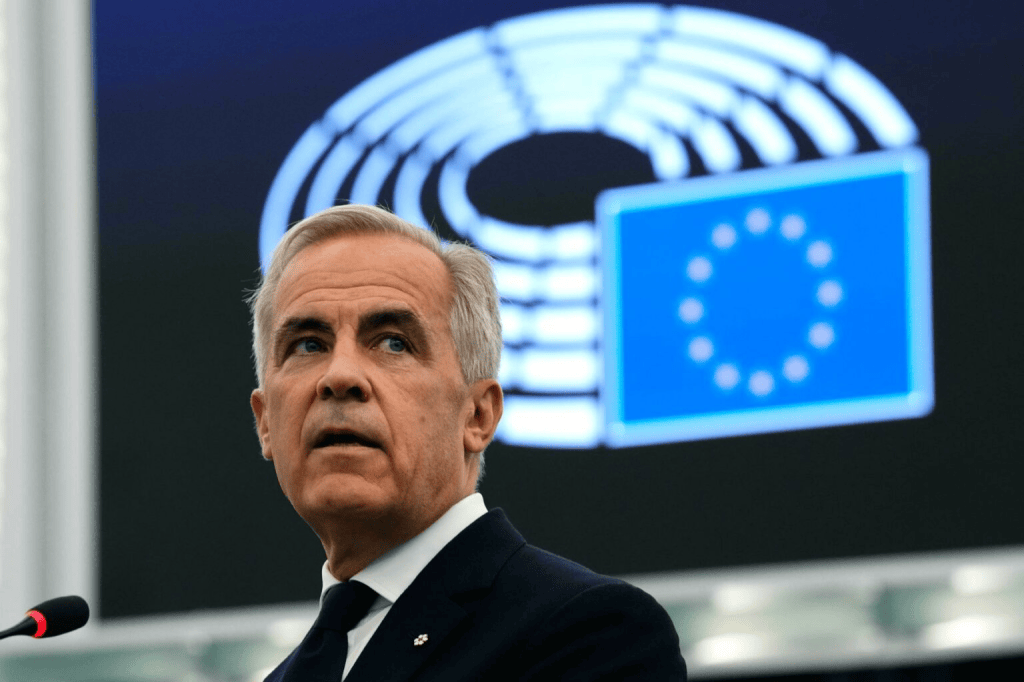
Key among the possible alternatives was to replay a variant of the Third Option of the 1970s by looking across the Atlantic. The new prime minister chose symbolically to make his first foreign trip not to Washington but to two European capitals, Paris and London. Describing Canada as the “most European of non-European countries” and noting pointedly that “it is more important than ever for Canada to strengthen its ties with its reliable allies,” he met with French president Emmanuel Macron, then British prime minister Keir Starmer, and King Charles III. Carney sought to work with the European Union and other Canadian allies “to build a new international, rules-based system.”
By June 2025, the Carney government had negotiated what was termed the “New EU–Canada Strategic Partnership of the Future”—a wide-ranging agreement that committed the European Union and Canada to work together on trade, economic security, digital transition, and climate change. Importantly, the EU and Canada also signed a new security and defence agreement, which was the first step in Canadian participation in Security Action for Europe (SAFE), part of the EU’s ReArm Europe/Readiness 2030 initiative.
This agreement was purposely broad in scope, with twenty areas of co-operation listed. Among them were co-operation on defending Ukraine, international peace and crisis management, interoperability and military mobility, maritime security, defence industrial matters, cyber security, counterterrorism, and foreign information manipulation and interference. Becoming an associate member of the EU feels only like the logical next step.
The Carney government may be the latest to draw inspiration from the idea that Canada is an Atlantic nation, but it’s unlikely it will be the last to look across the North Atlantic for a way to loosen America’s grip.
Posted on The Walrus, 25 September 2026, https://thewalrus.ca/bullied-by-the-us-canada-has-a-history-of-reaching-out-to-europe/. Adapted and excerpted, with permission, from Kim Richard Nossal, “Afterword: The Continuing Allure of the Atlantic Idea in Canadian Foreign Policy,” in Across the North Atlantic: Europe and Canadian Foreign Policy in the Cold War, edited by Asa McKercher and John Keess (McGill-Queen’s University Press, 2026), 341–48.

