Just days after he won the 2024 election, Donald J. Trump began talking about Canada becoming America’s 51st state. He has been pressing the case for annexation ever since — in social media posts, in interviews, and in speeches. He has posted a bizarre AI-generated image of himself on a mountain range with a Canadian flag, with the caption “Oh Canada” — the bizarreness of the post magnified by the fact that the mountain range featured a peak that looked like the Matterhorn. He has posted maps of North America, with Canada coloured as part of the United States. He has questioned whether Canada is a ‘viable’ country. He has claimed that the United States “subsidizes” Canada to the tune of billions of dollars a year. He has called the border between the two countries an “artificially drawn line” that that needs to be erased. He frequently asserts that “lots of Canadians” want to join the United States. He has consistently addressed Canadians directly, telling them that they would have lower taxes, better military security, and would not be subject to American tariffs if they became what he keeps calling, with Trumpian caps, “our Cherished 51st State.”
Many people regard the president’s talk of annexing Canada as a joke. Some argue that this is just Trump trolling Canadian Prime Minister Justin Trudeau, whom he deeply despises, for the lulz. Others suggest that it is part of an effort to bully Canadians into making a trade deal favourable to the United States.
It certainly began as a joke. Three weeks after the election, Trump announced that he would impose massive tariffs of 25 percent on all goods from Canada and Mexico until the two countries took measures to stop illegal migration and the smuggling of fentanyl into the United States. On 30 November, Trudeau hurriedly flew to Mar-a-Lago to plead Canada’s case. In an effort to convince Trump of the seriousness of the damage these tariffs would cause, Trudeau argued that they would “kill” the Canadian economy. The president-elect jokingly replied that “If Canada can’t survive without ripping off the U.S. to the tune of US$100-billion a year, then maybe Canada should become the 51st state” (Morrow and Chase, 2024). He also joked that Trudeau could become the “governor” of the new state. Days after this meeting, Trump began to repeat the 51st state mantra, replete with constant demeaning references to “Governor Trudeau”; he quickly bumped the $100 billion “subsidy” claim to $200 billion.
But it is now clear that what might have started as a joke got quickly transformed. It is equally clear that it the annexationist push is not some kind of four-dimensional chess move designed to soften up Canadians for a new trade deal. Rather, Trump’s constant references to annexing Canada should be seen as part of a broader expansionist agenda that was laid out explicitly in Trump’s Inaugural Address. America, the president promised in that address, would once again be a “growing nation,” one that “expands our territory” and “carries our flag into new and beautiful horizons” (United States, 2020). In other words, annexing Canada has to be seen in the context of Trump’s plans to “get” Greenland from the Kingdom of Denmark and to “take back” the Panama Canal from the Republic of Panama — a promise enshrined in the Inaugural Address. (In February 2025, Trump also promised to “take over” and “own” the Gaza Strip, and turn it into what he called the “Riviera of the Middle East,” but this appears to have been a random one-off idea that he quickly dropped, unlike the sustained attention he has devoted to Canada, Greenland, and the Panama Canal.)
Greenland is an integral part of Trump’s annexationist agenda for Canada. During his first term, Trump tried to buy Greenland from Denmark, and was furious that Mette Frederiksen, the prime minister, had the temerity to reject his offer. Trump immediately added Frederiksen to his long list of those he describes as “nasty women,” and cancelled a planned state visit to Denmark. But Greenland remained on his agenda: even before he was inaugurated in 2025, Trump ratcheted up his plans to “get” Greenland, going so far as to refuse to rule out the use of force to do so. On numerous occasions, he has claimed that the US “must have” the territory, threatening that “we will go as far as we have to” in order to get control of Greenland.
We know that Trump has been shown a Mercator-projection map of North America and Greenland; we know that he was impressed by the hugeness of both Greenland and the Canadian North conveyed by Mercator (Cassidy, 2025; Danforth, 2025). And it is clear from the way Trump talks that he is very much taken with the visual image of what the United States would look like if it absorbed Canada and Greenland.
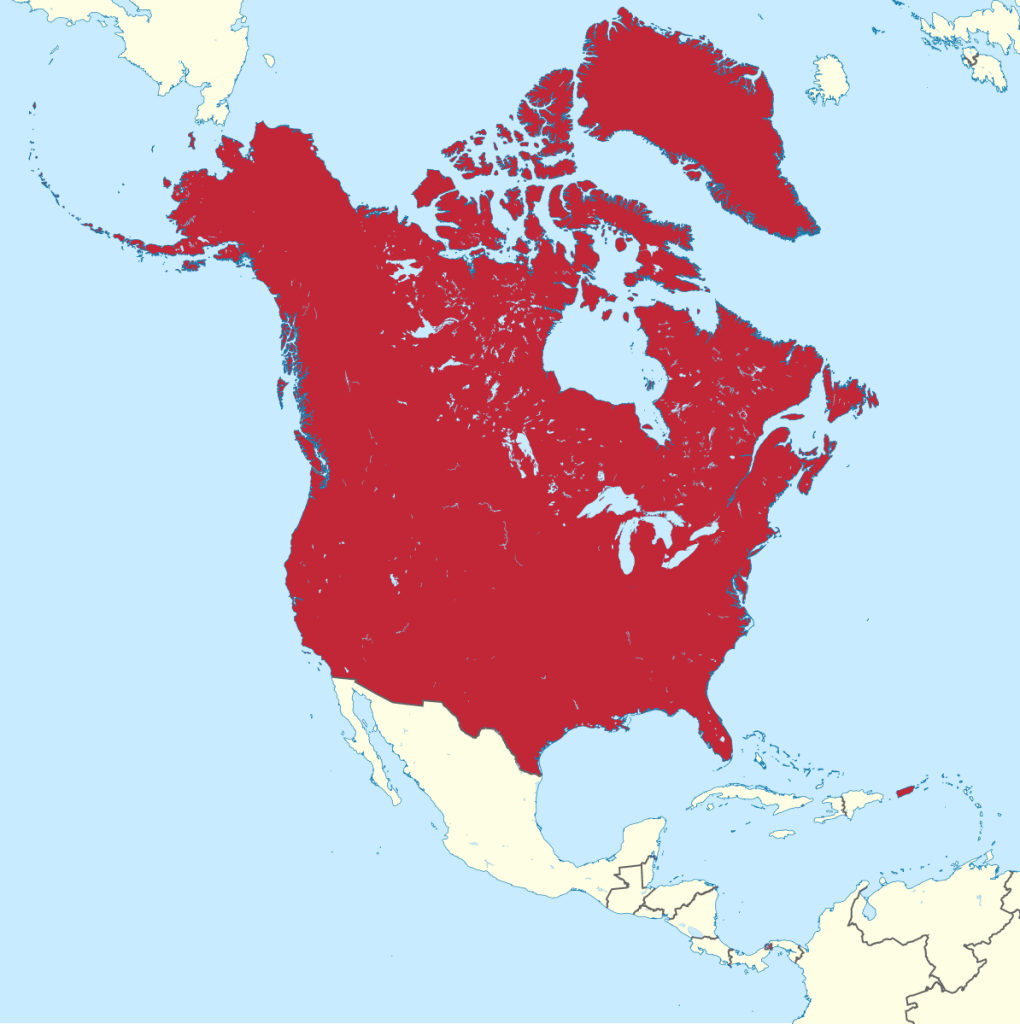
Source: courtesy of Nagihuin, Wikimedia Commons
For he constantly talks about how “beautiful” North America would be without the “artificial” line that, according to him, was drawn by “some guy [who] sat there with a ruler years ago.” He no doubt is also impressed at how vast the United States would become — at 22 million square kilometers, the largest country on Earth, vaster than China, and 4.9 million sq km larger than the Russian Federation.
One of the reasons why we need to take Trump’s fantastical Technicolor™ dreams of a USA that includes Canada and Greenland seriously is that his administration has embarked on a propaganda mission to convince Americans that both Greenland and Canada need to be seen as appropriate targets for absorption. In Greenland’s case, there has been a steady drumbeat of claims that the United States needs to control Greenland to ensure national security; that Denmark has not done an appropriate job defending Greenland against Russia and China; and that Denmark has not taken care of Greenlanders properly.
In Canada’s case, Trump has acknowledged that he is prepared to use what he has called “economic force” to secure annexation. And clearly the sweeping tariffs imposed on Canada in March and April 2025 are designed to do serious damage to Canadians. As Trudeau put it in March, the tariffs are intended to cause “a total collapse of the Canadian economy” because Trump thinks that will “make it easier to annex us.”
But in case tariffs do not do the job, the Trump administration has also sought to spread its clear animus towards Canada and Canadian sovereignty more broadly among American voters. Since November 2024, Trump and those around him have mounted an aggressive and organized propaganda campaign to try to convince Americans that Canada is no longer a friend of the United States, but instead has been complicit in the poisoning of the American people with fentanyl. Although the amount of fentanyl crossing the Canada-United States border is minuscule (only about 0.2% of all seizures of fentanyl entering the United States are made at the Canadian border), and although the U.S. intelligence community does not identify Canada as a drug threat, both the president and his vice-president, JD Vance, have openly accused Canada of not doing enough to stop fentanyl crossing the border. As Vance wrote on Twitter on 2 February 2025: “Spare me the sob story about how Canada is our ‘best friend’… Are they stopping the flow of drugs into our country? I am sick of being taken advantage of.” Other senior members of the Trump administration have leveled similar accusations: Peter Navarro, Trump’s trade counselor, has accused Canada of being controlled by Mexican cartels; Kevin Hassett, Trump’s economic adviser, has claimed that he has seen evidence that Canadian law enforcement agencies have refused to take action against major fentanyl labs operating in Canada.
On occasion the propaganda campaign has descended into the absurd. In March 2025, Kristi Noem, the secretary of homeland security, ordered that Canadians could no longer access the Haskell Free Library and Opera House as they had in the past. This library was built in 1904 as a celebration of Canadian-American friendship; it straddles the border in Stanstead, Québec and Derby Line, Vermont. Instead of being able to walk around the side of the building to the front door, which is located on the American side of the line, Canadians would now have to go through a formal port-of-entry border crossing before proceeding to the library. Noem’s justification? “Drug traffickers and smugglers” were taking advantage of the openness of the building.
But the organized campaign of lies has a clear and obvious purpose: as Timothy Snyder (2025) has argued, the conspiracy theory about Canada and fentanyl created by the administration is the kind of Nazi-style Big Lie, or große Lüge, that can only be understood in one way: as an effort to get Americans to see Canada as an enemy, and thus an appropriate target for crushing tariffs — or more severe action.
It may be tempting to interpret Trump’s annexationist babbling as a joke, or to refuse to take his Technicolor™ dreams seriously or literally. But Trump does not care about the sovereignty of smaller states like Canada, Denmark, or Panama. On the contrary: he manifests the kind of disdain for Westphalian sovereignty identified by Roland Paris in his landmark study of how China, Russia, and the United States have all embraced an approach to small powers that gives great powers, to use the title of Paris’s article, “the right to dominate” (Paris, 2020). And thus it is not at all surprising that when Trump talks about Canada and Canadians, he sounds exactly like Vladimir Putin, president of the Russian Federation, talking about Ukraine and Ukrainians. In such circumstances, Canadians might be forgiven for taking Trump’s annexation agenda both seriously and literally.
References
Cassidy, J. (2025). What imperialist game is Donald Trump playing with Greenland? New Yorker, 13 January. https://www.newyorker.com/news/the-financial-page/what-imperialist-game-is-donald-trump-playing-with-greenland.
Danforth, N. (2025). How big does Donald Trump think Greenland is? Foreign Policy, 14 February. https://foreignpolicy.com/2025/02/14/trump-greenland-obsession-map-threats/
Morrow, A. and Chase, S. (2024). Canada could be ‘51st state,’ Trump joked during Mar-a-Lago dinner with Trudeau. Globe and Mail, 3 December. https://www.theglobeandmail.com/world/us-politics/article-canada-could-be-51st-state-trump-joked-during-mar-a-lago-dinner-with/.
Paris, R. (2020). The right to dominate: How old ideas about sovereignty pose new challenges for world order. International Organization, 74 (Summer), 453–489. https://doi.org/10.1017/S0020818320000077.
Snyder, T. (2025). Blame Canada: Our war-mongering, drugged-out conspiracy theory. Substack, 16 March. https://snyder.substack.com/p/the-absurdity-is-the-point.
United States, White House. (2025). The inaugural address, 20 January. https://www.whitehouse.gov/remarks/2025/01/the-inaugural-address/.
Originally published as Kim Richard Nossal, “Dreaming in Technicolor™? Donald J. Trump and the Annexation of Canada,” The Round Table 114, no. 2 (2025), 148–51, https://www.tandfonline.com/doi/full/10.1080/00358533.2025.2489761.
 Kim Richard Nossal